
The Max software, created by Miller Puckette and currently developed and distributed by Cycling ’74, was designed in the 1980s as a graphical programming environment for musical creation, and has since then been used in several other artistic domains. But as a programming environment, Max can also be used for non-creative purposes; this article presents how it can be used as a tool for the musicological investigation of the repertoire of computer music. After an introduction to software-based approaches to the study of such a repertoire, an extensive research project dedicated to nine case studies serves as a basis for the discussion of key aspects of developments using Max in a musicological context. In this paper, the focus is on the potential afforded by Max in such contexts rather than on the particular musicological investigations. Perspectives for a generalization of this approach are therefore proposed, considering the modules created in this project according to their specificity, generality, or potential for abstraction beyond the work that motivated them. This ultimately leads to a consideration of Max as a tool for musicological research and analysis beyond the field of computer music.
INTRODUCTION
A graphical programming environment, the Max application1 distributed by Cycling ’74 is primarily aimed at and used for artistic and in particular musical creation. Its first application was the complex interaction between piano and live electronics in Philippe Manoury’s Pluton (1988, final version 1989), and it is now used as a key element in the creative toolset of countless musicians and artists of very diverse backgrounds and aesthetics. Of the most recent 100 projects, at the time of writing this article, developed by Max users and displayed on Cycling ’74’s project page,2 93 can be deemed creative in that they are either artistic outputs or tools to be used in a production, composition, or performance context; 93 are of musical or audiovisual nature. Despite such a significant artistic scope, Max is sufficiently generic an environment for its users to develop non-creative artifacts. In the TaCEM project (Technology and Creativity in Electroacoustic Music), funded by the United Kingdom’s Arts and Humanities Research Council (AHRC) and led by the three authors of this article,3 Max was used as the primary programming environment to conduct and disseminate a research of musicological order: the analysis of the interaction between compositional or performance processes and technology in nine important works of computer music. This project resulted in a recently published book accompanied by a Mac/PC application for each of these nine case studies [1], all built from Max, and demonstration videos constituting a bridge between the written chapters and the software.4 How can Max be used as a tool for musicology and music analysis? The second section of this article presents the implications of software-based approaches for the study of musics which exists primarily as sound – as opposed to those which rely on the intermediary support of the score, which have been historically dominant in Western musicology5 – and in particular the repertoire of computer music. Key aspects of Max-based developments are then, in the third section, discussed on the basis of the experience gained through the authors’ TaCEM project, with implications on both the research itself and its dissemination. Within a consistent but heterogeneous repertoire, a variety of analytical needs have been identified and addressed, Max in some cases proving a natural toolbox, in other cases showing limitations but ultimately enabling very positive analytical outcomes. Finally, the fourth section of the article considers the overall research and development process of this project in the light of the notions of specificity, generality, and abstraction.
SOFTWARE-BASED APPROACHES TO MUSICOLOGY
Interactive aural analysis and reconstructive approaches to the computer music repertoire
Interactive aural analysis, developed by Michael Clarke for the study of electroacoustic music and formally presented in [3], is a musicological approach proposing a substantial integration of software into the analytical processes and outcomes, where “the reader is presented with tools with which to explore aspects of the music for themselves alongside the author’s suggested interpretations.”6 Such a software-based approach can be applied to the investigation of the techniques used by the composers in the studio, whether they operate on audio signals or higher level representations, and to the organization of the musical work as a whole. If “visual representations and words alone may not be the ideal means by which to present an analysis of electroacoustic music,”7 the interactivity enables the approach not only to provide access to dynamically-evolving processes, but also to integrate the aural at the heart of the analysis.
This interactive aural approach was first implemented by Clarke in 2006 for the analysis of Jonathan Harvey’s Mortuos Plango, Vivos Voco (1980), where the written article is accompanied with a software application on DVD [4] enabling the reader to engage with interactive aural examples for the exploration of the composer’s techniques and his approach to timbre, harmony, and structure. Another publication was later realized in 2010 for the issue of Ina-GRM’s Polychrome Portraits dedicated to Denis Smalley, with an interactive aural analysis of Wind Chimes (1992), here too combining a written chapter and a standalone application [5]. The following year, an ethnographic study of the creative process and performance of Michael Finnissy’s Second String Quartet (2007) was jointly published by Amanda Bayley and Michael Clarke [6] – unlike the previous two analyses, the publication was entirely in software and distributed on DVD. In 2012, the three authors of this article initiated a large investigation of the computer music repertoire8 with both a contextual and historical approach and the development of interactive aural analyses for nine case studies: John Chowning’s Stria (1977), Barry Truax’s Riverrun (1986), Philippe Manoury’s Pluton (1988/1989), Hildegard Westerkamp’s Beneath the Forest Floor (1992), Francis Dhomont’s Phonurgie (1998), Trevor Wishart’s Imago (2002), Jonathan Harvey’s Fourth String Quartet (2003), Cort Lippe’s Music for Tuba and Computer (2008), and Natasha Barrett’s Hidden Values (2012). This resulted in the publication of the aforementioned monograph [1] with nine standalone applications and 105 demonstration videos, key aspects of which are considered in terms of developments in the third section of this article.
The interactive aural approach is related to other initiatives where a software-based approach is fundamental in the implementation of the musicological scrutiny. In an article from 2003 [7], Marc Battier proposed the concept of faktura as “a conceptual tool for analysis [which] may lead to using the method of reverse engineering. In this technique, the analyst turns back and follows the composer’s inverse path, the path from the final work to the initial ideas and materials, a paradigm which hopefully leads one to a description of the processes involved in making the piece and the production of the sound material.”9 Several musicologists undertook such a reconstructive approach to the computer music repertoire: in a 2007 issue of the Computer Music Journal, both Kevin Dahan and Olivier Baudouin proposed independent reconstructions of Chowning’s Stria [8, 9]. In 2011, Andreas Bergsland presented his Six Fantasies Machine (SFM), a program producing a range of sound similar to those of Paul Lansky’s Six Fantasies on a Poem by Thomas Campion [10]. In 2016, Sean Williams proposed a similar approach – all in the analogue domain – to research interpretation and performance practice in Karlheinz Stockhausen’s Studie II (1954) [11], a piece which Joachim Heintz had also reconstructed in software [12]. Also relevant is Alain Bonardi’s software reconstructions of Philippe Manoury’s live electronics in En écho with both musicological and preservation oriented concerns [13].
Max as a tool beyond musical creation
In 2002, Miller Puckette defined Max as a paradigm: “I have worked for many years on a computer environment for realizing live electronic music that I named in honor of Max Mathews. Three currently supported computer programs – Max/MSP, jMax, and Pd [Pure Data] – can be considered as extended implementations of a common paradigm I refer to here as ‘Max’.”10 In this article, we consider the actual Max software (in 2002 known as Max/MSP). Its primary scope is that of musical creation, but as David Zicarelli, CEO of Cycling ’74, the company which develops and distributes Max, specified in 2018, “Max started in music, but it’s increasingly used in art and architecture [university] programs.”11 We consider here Max as a programming environment – not a language – although it is important to recognize that this is a frequent point of discussion in its community of users and developers.12 For instance, Puckette wrote that “musicians have often used Max as a programming environment, at which Max succeeds only very awkwardly. […] Rather than a programming environment, Max is fundamentally a system for scheduling real-time tasks and managing communication among them. Programming as such is better undertaken within the tasks than by building networks of existing tasks. This can be done by writing ‘externs’ in C or C++, or by importing entire interpreters.”13
Considering that programming encompasses both the construction of networks of objects using the visual paradigm of patching and the possibility of integrating the textual via, for example, C and JavaScript, it is straightforward to see Max as a tool that can have applications beyond artistic creation, and in a very generic way. For the focus of this article, namely musicology and the analysis of creative processes using technology, and in particular our TaCEM project, several dimensions made Max a promising initial candidate. Its musical and audio orientation, the existence of a large library of objects and in particular graphical user interface ones, the possibility to integrate C externals for message, signal, and matrix data, and the opportunity to create a fixed standalone for both Mac and PC, led us to use Max consistently throughout the project. The following quotation by Lippe and Settel perhaps best summarizes the balance we found: “Using this [external code resource] platform, it is possible to combine the power of C with the convenience and speed of Max […], and development time can be quite rapid”14. Indeed, any programming environment – visual or not, music and audio-oriented or not – can lend itself to the development of a software-based approach to the study of music. Among the musicological examples introduced in section 2.1 above, Max was used for all cases of interactive aural analysis, from Mortuos Plango to Inside Computer Music; Dahan used Ruby and Csound, Baudouin used Python and Csound. Csound was also used by Bergsland and Heintz; Bonardi used Faust. In the forthcoming and third section of this article, we describe in more detail key elements of our experience designing the Inside Computer Music software with Max.
MAX AS A TOOL FOR CONDUCTING AND DISSEMINATING RESEARCH
The emulation of historic environments and generic processes
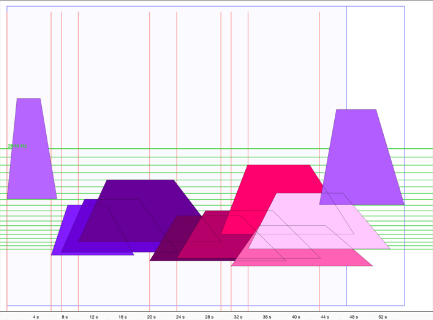
In order to give an understanding of the compositional environments and methods of the studied composers, we have, where potentially insightful and technically possible, undertaken their emulation. The first example of this was the investigation of John Chowning’s programs for Stria: the SAIL algorithm for the composition of event parameters – consistent sets of individual elements – was, following the aforementioned approaches in [8] and [9], replicated – here using JavaScript in a Max JSUI15 object enabling us to implement a fully interactive interface. In one of these interfaces, the user can experiment with the reproduction of the algorithm’s parameters of event structure, time, frequency, frequency modulation, and spatialization; the parametric changes are immediately visible graphically (figure 1) and the result audible (playback can operate on the event as a whole, or on individual elements; the reverberation can also be deactivated to focus on the sound of the dry frequency modulation).
With a second interface, we reproduced the step-by-step command-line interface, where the result is only audible once all parameters have been entered by the user. In both cases, the audio was simply implemented, for the two modulator / one carrier algorithm and the reverberation, with plain MSP16 objects, approaching the original MUSIC 10 synthesis design.17
Another emulation was that of GSX, the real-time system Barry Truax developed for granular synthesis, and used in his landmark work Riverrun. Like with Chowning, the publicly available documentation on the subject is excellent, enabling us to develop a first prototype – again, with a simple user interface using the JSUI object, in order to approximate Truax’s own terminal, and MSP objects, with custom C externals designed to trigger the grains specifically18. In this case, some further discussion with the composer and fine-tuning work alongside his original system was necessary, but our attempt was eventually successful at simulating the behavior of GSX.19
Studying Francis Dhomont’s Phonurgie, the opportunity to develop a simple model of Ina-GRM’s SYTER, the institute’s first real-time audio digital environment [19] developed as it became apparent that it had been extensively used by the composer for this piece and several others. Here, the motivation was not to reproduce exact materials, but to give the user – and indeed ourselves, as researchers – a better sense of the interaction with this environment. On the basis of available documents on the system,20 we reproduced the fundamentals of the user interface using a JSUI object and some audio processors in plain MSP objects. The scope of the project did not permit us to attempt a full emulation, but our final prototype gives a good account of the user interaction with the system, especially the interpolation ‘balls’ which enable all the parameters to be modified at once by navigating a two-dimensional screen between memorized presets, very much like the current Max nodes object.
In some cases, the implementation of generic techniques was sufficient to give a precise account of the composer’s process. Composing Beneath the Forest Floor, Hildegard Westerkamp experimented with field recordings and digital modules such as time-domain gating, speed variation resulting in transposition, delay, harmonization, reverse playback, or reverberation. Without knowledge of the specific implementation of those actually used, but with access to the composer’s archive of sound files for the work,21 generic implementations of such techniques proved useful in approaching the composer’s materials. These were implemented using standard MSP objects, with an external specifically developed for flexible playback with continuous signal rate speed control, including backwards, and looping, in conjunction with the TaCEM playback user interface. Studying Wishart’s Imago, a number of non-real-time processors, including several involving FFT and phase vocoding, were also implemented generically, which proved sufficient to give a detailed account of much of the composer’s creative process.22
Musicological refactorization of Max performance patches
Where Max is used as part of the creative process of a work being researched, using Max as environment for the analysis naturally facilitates the investigation; where the interactivity between performer and electronics relies on a patch, one can consider the electronic instrument as the direct subject of analysis [21]. In the TaCEM project, this was the case with Manoury, Harvey, Lippe, with different aesthetics, instruments (respectively piano, string quartet, and tuba), and interaction modes, but with a general patch architecture typical of IRCAM with the audio modules grouped in a “DSP” subpatch, and parameters controlled by sending event-tagged messages from qlist objects.
The performance patches are complex and, although logically organized and of course operational for performance purposes, they are difficult to scrutinize as is with musicological intentions. Our approach was first to try to extract each audio module, simple or complex, and make it available for independent exploration – in order to understand its expressive and aural potential outside the context of the work itself. This had been done with several interactive examples in a CD-ROM on Manoury’s works for real-time electronics [22]; in TaCEM, we systematized the approach to all available modules and parameters. The next step was then to understand – and communicate – how these modules where dynamically activated and used through the chronology of the works. In each of these three cases, the main and first interactive example shows a global graph, itself following the model of patching, with rectangular named objects representing either instruments or synthesis, sampling, and processing modules, interconnected with lines (figure 2).
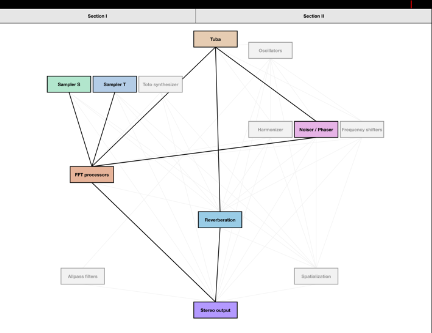
This representation gives a dynamic view of the evolution of the graph through the piece, facilitating the understanding of the implication of each audio module or message-driven process at any moment. Visually, generators and processors are greyed out when inactive; the thickness of lines indicates the gain assigned to the corresponding connection. Besides, each object can be bypassed by clicking and all its parameters can be viewed on a separate panel, enabling an actual interactive aural understanding of the contribution of specific techniques to the overall music. Parametric envelopes are also made available in a separate view, enabling the user to visualize the evolution of the behavior of any module while listening to a simulation of the performance of the work. In Natasha Barrett’s Hidden Values, and in particular its third section The Lock which we focused on, a Max patch embedding IRCAM’s Spat is used to control, during the performance, a variety of spatial processes in a high-order Ambisonics configuration. Here too, a refactorization of the patch has been made in order to facilitate the understanding of the contribution of the spatial processes and enable the user to mute specific tracks (played in Nuendo in Barrett’s configuration, in a sequencer developed as C external in our reconstruction) or play with processes independently.
Researching and disseminating
During the research for Inside Computer Music, Max was occasionally used as a tool to make quick prototypes to facilitate discussions with the composers and their collaborators. Once Francis Dhomont had provided us with his ProTools session, we started establishing hypotheses on the provenance of each track. To discuss these in more detail with Yann Geslin and the composer himself, we drafted a playback map with colors corresponding to our own categorizations – as opposed to the coloring and layout of the original ProTools six-track arrangement. A similar idea was implemented to discuss Hildegard Westerkamp’s materials; in the accompanying software, the video recording of this discussion is available as an interactive presentation23; and the subsequently developed and complete map of materials is made available as well24. Such maps were simply developed again using a JSUI object and the mgraphics library, and connected to simple MSP players for the audio playback.
For dissemination of the final software, the possibility to build standalone applications for Mac and PC from Max25 certainly helps us reach an audience of non-Max users; this also protects against accidental editing. Together with a user interface design that we intended as accessible as possible while providing detailed features and information, this mode of dissemination is adapted to those of our readers who may not be technological experts themselves.
FROM NINE CASE STUDIES TO A GENERALIZABLE MUSICOLOGICAL APPROACH
Specific components
When studying works where the elaboration of software tools for composition or performance is integral part of the compositional process, an interactive aural approach inevitably involves the development of specific components. For the writing of Inside Computer Music and its accompanying software, the emulation of Chowning’s SAIL algorithm for Stria, the interactive graphs representing the live interaction in Manoury, Harvey, and Lippe’s works, the sequencer/spatializer in Barrett’s The Lock are all examples of modules that were developed in an ad hoc way – they were dedicated to the analysed piece only, with no consideration for reusability or generalization beyond the study itself.
Generic components
Conversely, several tools developed during such a large-scale project were common to several cases and could be used in many other contexts. Amongst these are a simple but flexible audio sample player with a common user interface, used in all the interactive presentations where sample playback is required to experiment with sound transformation processes.26 Paradigmatic charts, developed in JavaScript, are used with different data but with a same software implementation in the analyses of Westerkamp, Dhomont, Wishart, and Barrett’s works. Likewise, a genealogic map showing links between materials from the initial sources to the final work was developed and used in both Westerkamp and Wishart’s cases, again with different data but with a same control/view implementation.
Generalizable software modules and abstraction
Considering specificity and generality, it is useful to look back and question which modules have been developed for the purpose of a specific case study, but could be generalized. Truax’s GSX could be used or developed further towards GSAMX in order to study more of the composer’s historic pieces with granular synthesis and granulation of audio files. Our emulation of SYTER could be expanded to study more of Dhomont’s works, as well as those by all the composers who used the system while at Ina-GRM. The interactive graphs in Manoury, Harvey, and Lippe could also be generalized and abstracted to accommodate an in-depth study of the live interaction in those of the pieces created at IRCAM which follow the same overall Max architecture.
In a more recent project, IRiMaS (Interactive Research in Music as Sound), funded by the European Research Council, the first two authors of this article are working on a generic toolbox developed in C++ with the JUCE framework, TIAALS (Tools for Interactive Aural Analysis) in order to enable musicologists to create their own analytical charts with no particular technical skills, but with access to advanced scrutinization tools for sound together with other media [23]. Although this current project is not dedicated specifically to computer music, the generality of its toolbox makes it adapted to the development of interactive aural analyses. The advanced study of musicians’ specific technological developments could not be envisaged in such a context, but research based on sound materials and their organization within the musical work would be largely facilitated by providing tools that do not require the detailed programming work that we invested in with the TaCEM project, hence fostering the directly musicological investigation.
CONCLUSION
As a particular case of a software-based approach to musicology and analysis of the creative process, interactive aural analysis involves a considerable amount of development. This is a rewarding investment in that the research and its dissemination are both tightly connected with sound by design, and an interactive approach with the studied processes is, in our experience of researching, presenting in conferences, and teaching, providing an understanding that would not be possible in traditional writing only. But this is only fully achievable if the end product is both easy to use while still providing a way in to the required level of detail. This is an aim that we hope to have achieved with Inside Computer Music.
In the process of developing such tools, where any programming environment could in theory be a candidate, Max proved itself an excellent choice – its own balance of user-friendliness and flexibility with advanced needs, in particular in audio, as well as the availability of a rich library of graphical tools, made it both possible to draft initial ideas quickly and to design end products as full applications, distributable as such on Mac and Windows
PC. On the other hand, for the more recent TIAALS, which is an advanced document editor integrating the manipulation of multiple media, Max showed limitations and we chose to undertake the development in JUCE which provides more control at the application level.
Overall, using Max enabled us in TaCEM to elaborate and share insights relating to the nine works we chose that go from introductions to the basic techniques at play to the large-scale organization and structure of these landmark examples of music created with computers.
Acknowledgments
This article presents a research that was originally developed as part of the TaCEM project funded by the United Kingdom’s AHRC. The TIAALS software mentioned in section 4 is being developed as part of the IRiMaS project, funded by the ERC (grant agreement no. 741904).
Frédéric Dufeu, Michael Clarke, Peter Manning
Copyright: © 2022 Frédéric Dufeu, Michael Clarke, Peter Manning. This is an open-access article distributed under the terms of the Creative Commons Attribution License 3.0 Unported, which permits unrestricted use, distribution, and reproduction in any medium, provided the original author and source are credited.
REFERENCES
[1] M. Clarke, F. Dufeu, and P. Manning, Inside
Computer Music. Oxford University Press, 2020.
[2] N. Cook, Beyond the Score. Music as Performance.
Oxford University Press, 2013.
[3] M. Clarke, “Analysing Electroacoustic Music: an
Interactive Aural Approach,” Music Analysis,
vol. 31, no. 3, pp. 347–380, 2012.
[4] M. Clarke, “Jonathan Harvey’s Mortuos Plango,
Vivos Voco,” in M. Simoni (ed.), Analytical Methods
of Electroacoustic Music. Routledge, 2006, pp. 111-
143.
[5] M. Clarke, “Wind Chimes: An Interactive Aural
Analysis”, in É. Gayou (ed.), Denis Smalley:
Polychrome Portraits. Ina-GRM/Michel de Maule,
2010, pp. 35-47.
[6] A. Bayley, M. Clarke, Evolution and collaboration:
the composition, rehearsal and performance of
Finnissy’s Second String Quartet. DVD, Palatine,
2011.
[7] M. Battier, “A Constructivist approach to the
analysis of electronic music and audio art - between
instruments and faktura,” Organised Sound, vol. 8,
no. 3, 2003, pp. 249-255.
[8] K. Dahan, “Surface Tensions: Dynamics of Stria,”
Computer Music Journal, vol. 31, no. 3, 2007, pp.
65-74.
[9] O. Baudouin, “A Reconstruction of Stria,”
Computer Music Journal, vol. 31, no. 3, 2007, pp.
75-81.
[10] A. Bergsland, “The Six Fantasies Machine – an
instrument modelling phrases from Paul Lansky’s
Six Fantasies,” Proceedings of the International
Conference on New Interfaces for Musical
Expression, Oslo, 2011, pp. 523-526.
[11] S. Williams, “Interpretation and Performance
Practice in Realizing Stockhausen’s Studie II,”
Journal of the Royal Musical Association, vol. 141,
no. 2, 2016, pp. 445-481.
[12] J. Heintz, “Re-generating Stockhausen’s Studie II in
Csound,” Proceedings of the Linux Audio
Conference, Utrecht, 2010, pp. 65-74.
[13] A. Bonardi, “Analyser l’orchestre interactif dans
l’œuvre de Manoury,” in A. Bonardi, B. Bossis, P.
Couprie, and V. Tiffon (eds.), Analyser la musique
mixte. Delatour, 2017, pp. 83-97.
[14] M. Puckette, “Max at Seventeen,” Computer Music
Journal, vol. 26, no. 4, 2002, pp. 31-43.
[15] R. Rowe, B. Garton, P. Desain, H. Honing, R.
Dannenberg, D. Jacobs, S. T. Pope, M. Puckette, C.
Lippe, Z. Settel, and G. Lewis, “Editor’s Notes:
Putting Max in Perspective,” Computer Music
Journal, vol. 17, no. 2, 1993, pp. 3-11.
[16] M. Clarke, F. Dufeu, and P. Manning, “Using
Software Emulation to Explore the Creative and
Technical Processes in Computer Music: John
Chowning’s Stria, a case study from the TaCEM
project,” Proceedings of the International Computer
Music Conference, Utrecht, 2016, pp. 218-223.
[17] E. Lyon, Designing Audio Objects for Max/MSP and
Pd. A-R Editions, 2012.
[18] M. Clarke, F. Dufeu, and P. Manning, “From
Technological Investigation and Software Emulation
to Music Analysis: An integrated approach to Barry
Truax’s Riverrun,” Proceedings of the International
Computer Music Conference, Athens, 2014, vol. 1,
pp. 201-208.
[19] D. Teruggi, Le système SYTER. Son histoire, ses
développements, sa production musicale, ses
implications dans le langage électroacoustique
d’aujourd’hui. Doctoral thesis, Université Paris 8,
1998.
[20] J.-F. Charles, “A Tutorial on Spectral Sound
Processing Using Max/MSP and Jitter,” Computer
Music Journal, vol. 32, no. 3, 2008, pp. 87-102.
[21] F. Dufeu, “L’instrument numérique comme objet
d’analyse des musiques mixtes,” Proceedings of
Journées d’Informatique Musicale, Rennes, 2010,
pp. 221-227.
[22] M. Battier, B. Cheret, S. Lemouton, and P. Manoury
(eds.), PMA LIB. Les musiques électroniques de
Philippe Manoury. CD-ROM, IRCAM-Centre
Georges Pompidou, 2003.
[23] F. Dufeu, K. Takahashi, A. Roebel, and M. Clarke,
“The IRiMaS Software: Integrating interactive
listening and play into musicological research,”
Proceedings of the International Computer Music
Conference, New York, 2019.
- This initial definition of Max as graphical programming environment is itself subject to discussion, as briefly discussed in section 2.2. In this introduction, it is used to present both the capacity of the software to offer a space for programming and developing prototypes and products, and its primarily graphical paradigm – also found in Pure Data or OpenMusic, as opposed to the textual paradigm of code-based environments such as Csound. SuperCollider, or ChucK, to name several other important programming environments dedicated to musical creation. ↩︎
- https://cycling74.com/projects/page/1 (last visited 9th May 2022). The projects considered for this indicator were from Plecto LFO – Non-Linear Parameter Control by Steffanianigro (published on 20th August 2020) to a10 by Motoko (published on 15th December 2021). ↩︎
- See https://research.hud.ac.uk/institutes-centres/tacem/ (last visited 9th May 2022). ↩︎
- The software can be freely downloaded from https://pure.hud.ac.uk/en/datasets/inside-computer-music-accompanying-software (last visited 9th May 2022) ↩︎
- See for instance [2], p. 17. ↩︎
- [3], p. 355. ↩︎
- Ibid. ↩︎
- Computer music is here considered in a large sense, and includes works of computer music heard in the stricter, historic sense (Chowning, Truax). Based in Europe, the project used the terminology “electroacoustic music”. ↩︎
- [7], p. 254. ↩︎
- [14], p. 31. ↩︎
- In an interview published on the website of the JUCE audio framework entitled “Building Max in JUCE. David Zicarelli of Cycling ’74 discusses building Max with JUCE”, https://juce.com/discover/stories/building-max-with-juce (last visited 9th May 2022). ↩︎
- See in particular the discussion initiated by Peter Desain and Henkjan Honing, continued by Roger Dannenberg, Dean Jacobs, Cort Lippe and Zack Settel, Stephen Travis Pope, Miller Puckette, and George Lewis, and reproduced by Robert Rowe and Brad Garton in [15]. ↩︎
- [14], p. 39. ↩︎
- Cort Lippe and Zack Settel, quoted in [15], p. 7. ↩︎
- JSUI stands for JavaScript User Interface. ↩︎
- MSP stands for Max Signal Processing: the corresponding objects, ending with the tilde (~), are dedicated to audio rate signals. ↩︎
- For more detail on the methodology of this case study, see [16]. ↩︎
- In addition to the Max SDK documentation, a very useful resource for the design of Max and MSP C externals was [17]. ↩︎
- A fuller account of this study of Riverrun is available in [18]. ↩︎
- Both publicly available in [19] and kindly provided by Yann Geslin. ↩︎
- As kindly provided by Westerkamp, along with notes documenting the sound files, greatly facilitating the reconstruction of their genealogy. ↩︎
- These non-real-time processors emulating Wishart’s techniques were initially developed as Jitter externals and objects, following an approach inspired by Jean-François Charles [20]. Ultimately, we rewrote those as plain Max externals, using the buffer API. ↩︎
- In presentation 14: “Listening to the materials of Beneath the Forest Floor.” ↩︎
- In presentation 15: “Paradigmatic analysis of the work.” ↩︎
- The advice provided by Dan Nigrin in his presentation “Making A Slick Max Standalone” at Expo ’74 in 2011 was very helpful in this compilation process. See https://cycling74.com/forums/making-a-slick-max-standalone-expo-74-presentation-available (last visited 9th May 2022). ↩︎
- This player was used in all case studies except Chowning’s Stria. Initially prototyped in mono/stereo, it was adapted for multichannel when studying the spatialization processes in Barrett’s The Lock. ↩︎