
John Chowning’s Stria,
a case study from the TaCEM project
The TaCEM project (Technology and Creativity in Electroacoustic Music) has investigated the relationship between technological innovation and compositional processes on the basis of nine case studies, including John Chowning’s Stria (1977). Each case study involved researching the historical and contextual background of the work, emulating the technology used to create it and analyzing its musical structure. For each of these electroacoustic works, a specially designed software package has been developed, forming an important part of the project outcome. If Stria, as a classic work of the electroacoustic repertoire, has been much written about, the study presented in this article is distinctive in that the software enables to present the results of this research in an interactive and aural form: its users can engage directly with the structure of the work and the techniques and processes used by Chowning to compose it. This article presents this interactive aural analysis approach, its application to Stria, and the interactive resources embedded into the resulting software.
INTRODUCTION
Researching music in which technology plays an integral part in the creative process presents particular challenges as well as opportunities for musicologists. This is particularly the case in works where technology has changed the way in which the music is conceived and where detailed knowledge of the technology therefore plays a crucial part in developing a full understanding of the creative process. The task becomes more difficult in cases the technology used to produce the original work no longer exists. But even where the technology does exist, it may not be easily available to a wide range of researchers or may not be in a form they will find accessible. Written documentation and description can give some indication of the technical system but is no substitute for the knowledge that can be gained from exploring a working version, trying out different options and hearing the results in a hands-on environment. And this is also especially important in connecting technical investigation with research into the musical structure of a work, exploring how the technical and creative interact. These relationships are crucial to a well-informed understanding of the works concerned, not least in terms of how the associated technologies have influenced the creative process. Although the importance of thus engaging with the Techné or art of bringing forth such works via a technical medium has been recognized for many years – see for example articles written by Di Scipio in 1995 [1] and Manning in 2006 [2] – the development of suitable tools for such investigations has still a long way to go. In the TaCEM project, Technology and Creativity in Electroacoustic Music1, a 30-month project funded by the Arts and Humanities Research Council in the UK, the authors have attempted to address these issues by creating interactive software to help investigate both the musical structure of works and the processes that led to their creation. This approach builds on Clarke’s earlier work on Interactive Aural Analysis [3]. The main output of our project will be a book with substantial accompanying software. John Chowning’s Stria is one of nine case studies examined for the project. Each case study involves researching the background to the work, emulating the technology used to create it and analyzing its musical structure2. With each of our case studies, a specially designed software package forms an important part of the outcome. Stria is a classic of the electroacoustic repertoire and, as such, much has previously been written about it, most notably in a 2007 edition of the Computer Music Journal [5, 6, 7, 8]3. What makes our study distinctive is the way software enables us to conduct our research and present it from an interactive aural perspective, and in so doing explores the characteristics of the works being studied in greater depth. We can investigate technological aspects by working with models that emulate the processes employed and comparing our results with the original. We can examine the significance of the choices the composer made in shaping the work by trying out alternative parameter settings within their creative environment and evaluating the results aurally. We have drawn on previous work on Stria and have also benefitted greatly from the help and advice of John Chowning himself. Video interviews we conducted with the composer during a visit to Stanford form another important aspect of our software package, adding a poietic perspective. Another very significant aspect of our study, one not represented in this paper, is contextual research, placing the work in its wider technical and musical context. The purpose of this paper is not to give a full analysis of Stria (that will appear in the book arising from the project) but rather to provide an introduction to our working methods together with the software and to demonstrate and discuss the advantages of approaching this type of repertoire through the use of interactive resources.
OVERVIEW OF THE SOFTWARE
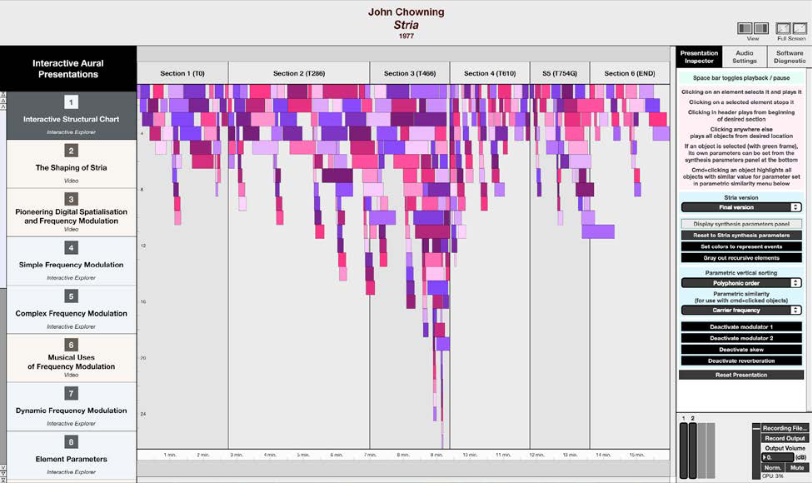
The software for our study of Stria incorporates various different components, combining technical study, musical analysis and video interviews with the composer. The associated text, in a book chapter, provides further contextual information and more detailed explanation of the technical and creative issues presented in the software. To gain most from these materials, the text and software need to be studied in tandem and the chapter will contain links to video demonstrations of the software to facilitate this articulation. The software package for Stria comprises seven interactive explorers, interleaved with related video extracts from our interviews with the composer. Figure 1 provides an overview of the TaCEM software for the study of Stria.
INTERACTIVE EXPLORERS
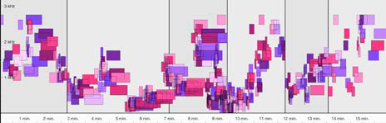
The first interactive presentation is an Interactive Structural Chart. As seen in figure 1 above, this chart sets out all the “elements” that comprise Stria in temporal order from left to right along the horizontal axis. “Element” is the term Chowning uses for the smallest component of the work, roughly equivalent to a “note” in a traditional score. These elements come together to form the “events” which in turn build up the six “sections” of Stria. In our interactive structural chart, individual elements can be heard by clicking on them and, alternatively, the whole texture at any point in the work may be played. The criteria used to order the vertical arrangement of the elements can be changed by the user from a menu in the presentation inspector, on the right side of the window. The default option, as on figure 1, simply presents the elements in polyphonic order, so that overlapping elements are stacked vertically. However, any of the individual synthesis parameters used in the creation of Stria may determine the vertical arrangement. For example, the carrier frequency, either of the two modulation frequencies, the reverberation amount or the distance factor can be represented on the vertical axis. In this way, an overview of the shape of the work can be seen from many different perspectives. Importantly, because of the interactive aural nature of the chart, seeing can be linked directly to hearing. The sounds presented in this chart are synthesized live by the emulation software and this means that it is possible in listening to examples from this chart to bypass certain aspects of the synthesis process so that their significance and contribution to the overall sound can be perceived and understood. The aspects that can be deactivated are the operation of the two modulators, the skew (a small dynamic pitch variation adding richness to the overall sound) and the reverberation. Interestingly, the shape of the work as shown (and heard) by this interactive chart, for example when ordered by carrier frequencies (figure 2), does not correspond neatly to the “V”-shape frequently portrayed, for example on the cover of the aforementioned 2007 issue of the Computer Music Journal (figure 3). It is not clear what specific data, whether parameter data inputted or outputted results, was used to draw this shape, though it does correspond to the composer’s own description of the shape of the work (for example, in our interviews with him)4. In terms of the parameters shown in our Interactive Structural Chart, the form of the work, although generally following this shape, is a far more complex interaction with many contributing factors. Being able to identify and explore such issues is one of the advantages of working directly with an interactive emulation of the technology and with flexible visualization features.
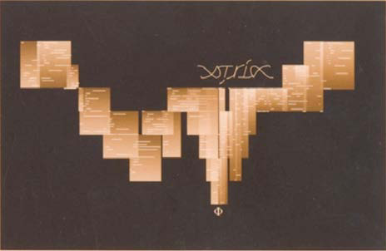
the 2007 issue of the Computer Music Journal
The next group of interactive explorers relate to the synthesis method used in the work. This is the frequency modulation (FM) method, famously developed by Chowning himself and later used in many different software packages and patented for use in commercial synthesizers by Yamaha. Three interactive explorers introduce the reader in stages to this synthesis method and how it is used in Stria. Firstly, the basic principles of FM are introduced followed by the more complex, two-modulator version of FM used in Stria. Our interactive software enables users to try out the technique for themselves either using examples of the input data from Stria itself or inputting their own settings. The software has an option to display numerical data about the frequencies generated by the modulation process (the frequencies of the sidebands), as well as showing them graphically (figure 4). Displaying this data numerically is useful in analyzing the often complex results arising from two-modulator FM synthesis. Indeed, it is particularly helpful in exploring the significance of the ratio used by Chowning in this work (the Golden Mean) and what this means in terms of the timbres generated.
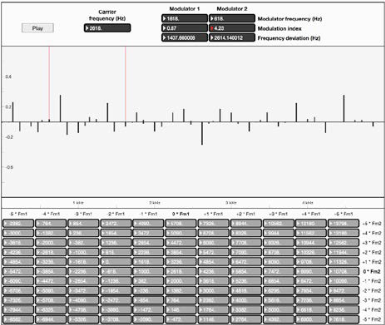
sideband frequencies
The next interactive FM explorer demonstrates the potential of dynamic evolution of timbres in FM synthesis using envelopes to shape parameters (figure 5).
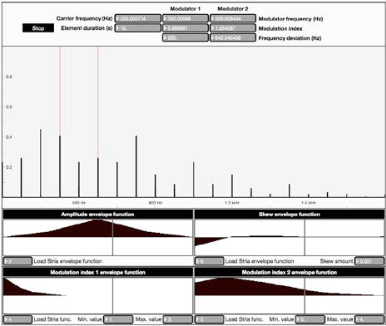
The software displays the envelopes and these can be changed interactively to facilitate greater understanding of their importance through direct aural experience.
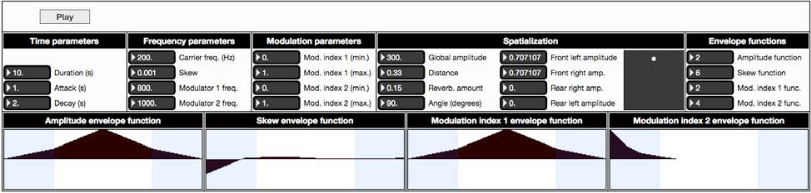
A further interactive explorer builds on the FM examples already introduced and extends them to include all the parameters involved in defining an element in Stria, including spatialization. In this explorer, the user can shape individual elements using the same parameters as used to control the synthesis engine in Stria. These synthesis parameters are grouped according to the following categories: time parameters, frequency parameters, modulation parameters, spatialization, and envelope functions (figure 6). A two-dimensional surface enables to set the amplitudes of the four output channels by providing an angle directly. The envelope layout highlights Chowning’s specific use of the terms “attack” and “decay” in Stria: the attack setting, in seconds, determines the time to go through the first quarter of the envelopes. Likewise, the decay setting determines the time to go through the last quarter of the envelopes. Interacting with this explorer reveals, by modifying the duration, attack and decay parameters and watching the playhead on the envelope panels, the non-linear indexing of Chowning’s functions.
In the composition of Stria itself, Chowning did not shape the elements individually. Instead, the composer programmed an algorithm to do this work, with him inputting data to higher-level parameters he created to define the structure of a whole event. Unlike our emulation, Stria was produced using software that did not operate in real-time. Indeed, there were significant delays waiting for sounds to be generated. In our interviews, the composer described the advantages he found in working in this way: it gave him time to reflect and plan at a time when many of the ideas and techniques he was employing were new and unexplored. Furthermore, the piece was not produced directly in a single process but in two successive stages. The first stage, using the program the composer himself constructed in SAIL (Stanford Artificial Intelligence Language), used algorithms to generate the data defining the elements comprising each event in the work. To realize these elements in sound, a second stage was then required, in which the data generated by the SAIL algorithm was imported into Music 10 as score data and the sounds were then generated (again, not in real-time). The Music 10 orchestra for Stria remains fixed throughout the work and generates sounds using the two-modulator FM synthesis algorithm mentioned above, with the addition of global reverberation and four-channel spatialization.
In our software emulation of the whole process, these two separate stages are combined into one and the whole operation is run in real-time. Despite the benefits Chowning found in not working in real-time when composing the work, in the context of studying the music and its technical and creative processes, real-time has the advantage of allowing readers to engage more directly with the music as sound and helps develop an understanding of the aural significance of particular parameters and of the settings chosen by the composer. As a default, users are provided with the original settings Chowning used in Stria, but they may also input their own alternatives, either using an emulation of the composer’s original interface, inputting data one item at a time in response to onscreen prompts (figure 7), or using a more modern graphical interface (figure 8). Chowning’s original SAIL program takes the user parameters and inputs the data from these into an algorithm that calculates the individual elements for a particular event. The algorithm is determinist: inputting the same data will always result in rigorously the same outcome. To the novice user, the significance of the input parameters may not be immediately obvious, especially when encountered in the original command-line format. This is particularly the case as some aspects of the resulting sound (for example the fundamental pitch of an element) are influenced by the interaction of several different parameters (in the case of the fundamental frequency these include range, division of this range, multiplier, etc.). To make this easier to understand and to show the effect of changing parameter settings, our software emulation incorporates visual displays of the parameters and the resulting elements. Furthermore, to facilitate conceptual understanding of how Chowning’s design of the algorithm enables him to shape the music, the emulation includes the option of showing visually how an event is formed step by step, starting with temporal definitions for events and the elements they contain (for the event: start time, duration, attack duration5; for the elements: start positions and durations), then frequency definitions (base frequency, frequency space), followed by modulation parameters, element attacks and decays, and spatialization. In this way, the creative and technical thinking behind the algorithm is revealed.
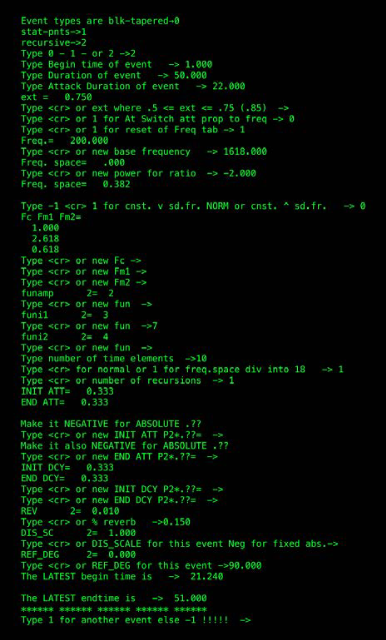
create one event in Stria
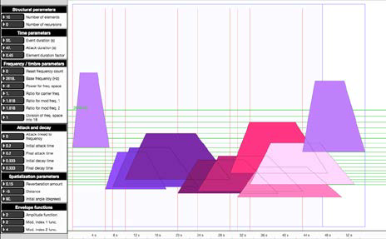
one event
VIDEOS
Our analytical and technical investigations into Stria are complemented by poietic material in the form of interviews with the composer that we conducted over three days in March 2015. Extracts from these interviews are interleaved with the software presentations so that topics explored through the software appear alongside related discussions with the composer (figure 9). These interviews will also be referenced and in part transcribed in the accompanying book text. The topics covered by the interviews range from specific issues relating to the composition of Stria to general discussion of the FM synthesis technique, to much broader topics concerning the Chowning’s career and his more recent compositional concerns.
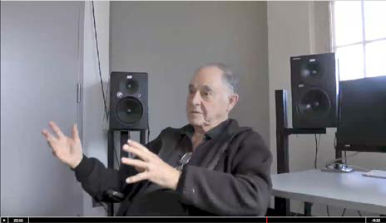
CCRMA in Stanford (March 2015), as embedded
amongst the presentations in the TaCEM software
In total there are nine videos of varying length. They are entitled according to the following topics: The shaping of Stria; Pioneering digital spatialization and Frequency Modulation; Musical uses of Frequency Modulation; Approaches to programming (SAIL and Max); The different versions of Stria; Encounters and interactions with JeanClaude Risset; Academic and commercial impact of Chowning’s work; Chowning’s compositional process and career; and From Stria (1977) and Phoné (1981) to Voices (2005). In this way, the detailed and specific study of Stria and the technology behind it can be related to the composer’s creative intentions and to the broader picture of his contribution to the development of computer music.
CONCLUSION
Combining software with written text and filmed interviews enables those who use our resources to gain a deeper understanding of a work, in this case Stria, than would be possible using text alone:
– they can discover the potential of synthesis techniques by working with them rather than just reading about them as theory;
– they can explore the musical shape of works as sound;
– they can hear the musical impact of the choices the composer made;
– they can see and hear composers giving their own accounts of the works and their broader context.
Especially as, over time, many of the original technical resources employed in particular works become obsolete, our approach of creating good approximations to these technologies helps to ensure that detailed understanding of those technologies and of what it was like to work with them is preserved. Furthermore, the articulation of software, text and interviews helps to preserve and transmit to new generations lessons learnt about the successful combining of technical knowledge and creative inspiration. Indeed, in trialing these materials in a pedagogic context we have discovered their potential for bringing together aspects of music technology teaching that are more often kept as isolated units: students can learn about the history of computer music, they can explore techniques (e.g. FM synthesis), they can investigate how a particular work is structured musically and, using our emulation software if they wish, they can try out creative ideas inspired by all that they have learnt, producing their own compositional sketches. In a digital age, surely it does not make sense to rely solely on written text to try and convey matters relating to sound, complex technology, and creativity. Engaging with this repertoire aurally and interactively adds an important additional dimension to the mode of enquiry and significantly enriches what can be conveyed and learnt.
Michael Clarke, Frédéric Dufeu, Peter Manning
Copyright: © 2016 Michael Clarke, Frédéric Dufeu and Peter Manning. This is an open-access article distributed under the terms of the Creative Commons Attribution License 3.0 Unported, which permits unrestricted use, distribution, and reproduction in any medium, provided the original author and source are credited.
REFERENCES
[1] A. Di Scipio, “Centrality of Techné for an Aesthetic
Approach on Electroacoustic Music”, Journal of
New Music Research, vol. 24, no. 4, 1996, pp. 369-
383.
[2] P. Manning, “The significance of Techné in
Understanding the Art and Practice of
Electroacoustic Composition”, Organised Sound,
vol. 11, no. 1, 2006, pp. 81-90.
[3] M. Clarke, “Analysing Electroacoustic Music: an
Interactive Aural Approach”, Music Analysis,
vol. 31, no. 3, 2012, pp. 347-380.
[4] M. Clarke, F. Dufeu, P. Manning, “From
Technological Investigation and Software Emulation
to Music Analysis: An integrated approach to Barry
Truax’s Riverrun”, Proceedings of the 2014
International Computer Music Conference / Sound
and Music Computing conference, Athens, 2014,
vol. 1, pp. 201-208.
[5] M. Meneghini, “An Analysis of the Compositional
Techniques in John Chowning’s Stria”, Computer
Music Journal, vol. 31, no. 3, 2007, pp. 26-37.
[6] L. Zattra, “The Assembling of Stria by John
Chowning: A philological investigation”, Computer
Music Journal, vol. 31, no. 3, 2007, pp. 38-64.
[7] K. Dahan, “Surface Tensions: Dynamics of Stria”,
Computer Music Journal, vol. 31, no. 3, 2007,
pp. 65-74.
[8] O. Baudouin, “A Reconstruction of Stria”,
Computer Music Journal, vol. 31, no. 3, 2007,
pp. 75-81.
[9] B. Bossis, “Stria de John Chowning ou l’oxymoron
musical : du nombre d’or comme poétique”, in
É. Gayou (ed.), John Chowning. Portraits
Polychromes, Paris, Ina-GRM, TUM-Michel de
Maule, 2005, pp. 87-105.
[10] C. Dodge, T. Jerse, Computer Music. Synthesis,
Composition, and Performance, 2nd ed., London and
New York, Schirmer, 1997.
- http://www.hud.ac.uk/research/researchcentres/tacem/ (last visited May 11, 2016). ↩︎
- See for instance [4]. ↩︎
- See also [9]. ↩︎
- Another “V”-shape can be found in [10], p. 137. As Zattra notes in [6], p. 45, “Dodge and Jerse consider this [latter] figure a sketch of the shape (without any claim to be precise in details) of the 18-minute piece”. ↩︎
- In the terminology of Stria and its programs, the attack duration of an event is the duration within which new elements can be generated. If an event has a duration of 60 seconds and an attack duration of 30 seconds, no new element will appear during the second half of the event. ↩︎